Building an Open-Source Guitar Recording Workstation
After completing development work for the day, I utilize the same machine for guitar practice and recording. The system functions as a Linux-native recording workstation built on a dual-use development setup. Running a stack comprised of ALSA, PipeWire, and Reaper, this environment provides stable, low-latency recording. The setup prioritizes control and consistency.
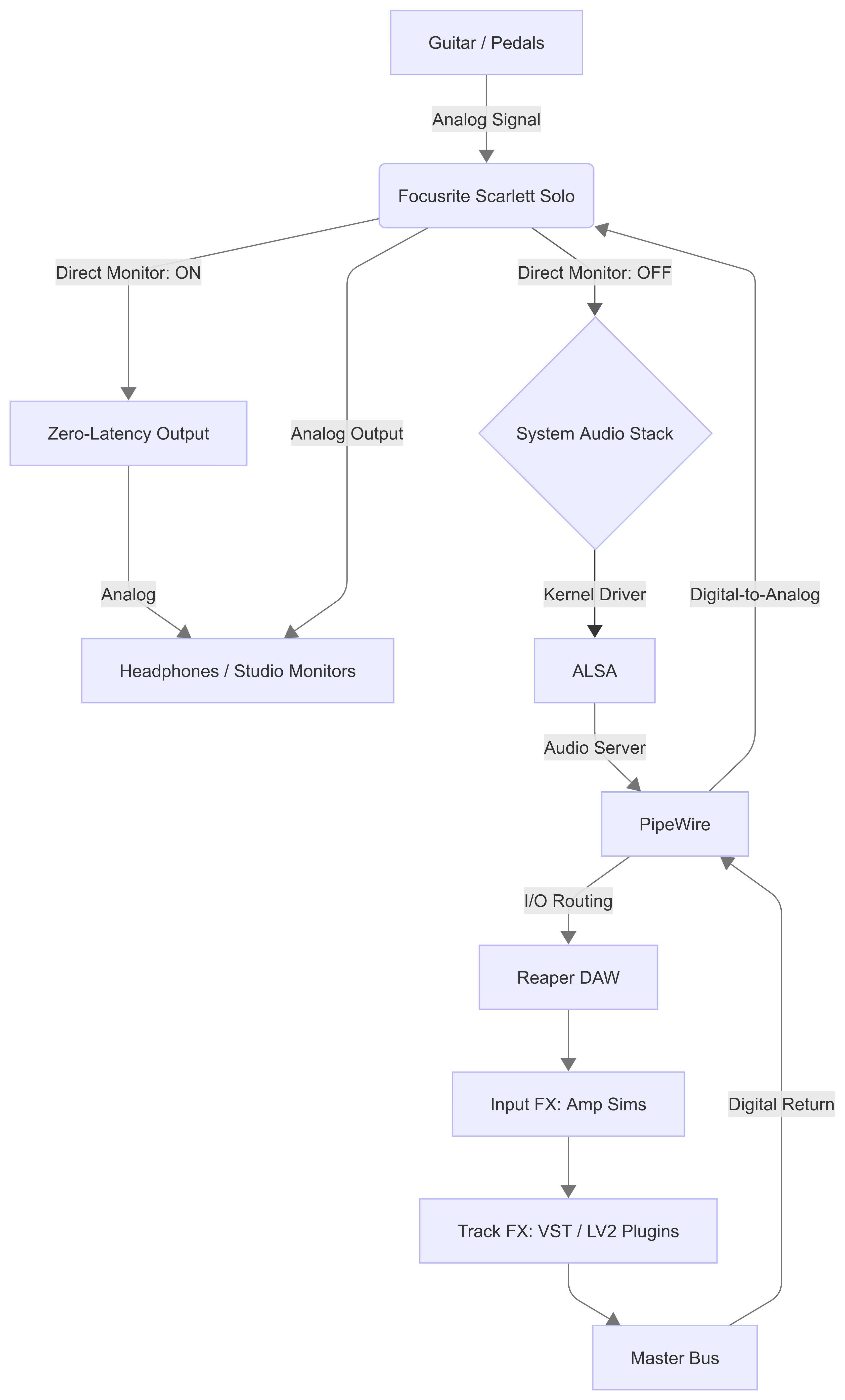
Below is an abstract overview of the build architecture:
Hardware Setup
The core of this setup is a Focusrite Scarlett Solo (2nd Gen). I leverage the hardware-level Direct Monitor and Instrument (INST) modes to optimize the signal chain before it even reaches the OS.
- Direct Monitor: Routes the input signal directly to the output, providing zero-latency monitoring for practice.
- INST Mode: Optimizes input impedance specifically for high-output guitar signals.
This configuration creates two distinct operating states. First is a Hardware-Monitored Practice Mode for minimal latency during standing practice. Second is a Full DAW-Monitored Mode, where the signal is routed through Reaper for real-time amp simulation and effects processing. Centralizing the monitoring through the interface simplifies routing and maintains a consistent audio environment.
Software Setup
Reaper was selected as the primary DAW due to its lightweight architecture and robust Linux compatibility. By utilizing Direct Input (DI) recording with software-based amp simulation, I’ve eliminated variables like room acoustics and microphone placement. This ensures the signal chain remains clean, controllable, and reproducible across sessions.
Navigating the Linux Audio Trade-offs
Operating a professional audio stack on Linux involves known trade-offs:
- Ecosystem Constraints: The plugin market is primarily optimized for macOS/Windows; however, native LV2 and VST3 formats provide high-quality alternatives.
- Documentation-Driven Troubleshooting: Unlike mainstream “plug-and-play” systems, resolving driver quirks or routing adjustments requires deep dives into forums and manual configuration.
- System Familiarity: Success depends on a baseline understanding of the Linux audio stack (ALSA and PipeWire).
The result of this effort is increased transparency and system-level control. This level of customization allows me to share my specific FX Chains and software configurations with the community via GitHub.
Conclusion
This workstation is the result of incremental decisions to move away from proprietary setups in favor of a Linux-native environment. I am proud to have evolved this system into a reliable tool for both my music and my code. I am grateful to my mate for the support and resources that allowed me to focus on this build.